Tag: D2C

  • Best Payment Gateways for Ecommerce in India 2026: Razorpay vs Cashfree vs PayU vs Instamojo

    Why Your Payment Gateway Choice Matters More Than You Think

    A 2-second delay at checkout costs you 5-7% conversions. A failed payment attempt loses 30% of those customers forever. The wrong payment gateway doesn’t just cost you in fees — it costs you in lost sales.

    For Indian D2C brands, the payment gateway needs to handle UPI (50%+ of online transactions), support COD toggling, offer fast settlements, and integrate cleanly with Shopify or WooCommerce.

    We’ve integrated all four major gateways across 200+ stores at Growww Tech. Here’s our unbiased breakdown.

    Quick Comparison Table

    Feature Razorpay Cashfree PayU Instamojo
    Transaction fee 2% 1.90% 2% 2% + ₹3
    UPI fee 2% 1.90% 2% 2% + ₹3
    Settlement time T+2 (instant available) T+1 to T+2 T+2 to T+3 T+3 to T+5
    Shopify integration Native (best) App available App available Limited
    WooCommerce plugin Official plugin Official plugin Official plugin Official plugin
    Payment links Yes Yes Yes Yes (core feature)
    Subscriptions Yes Yes Limited Yes
    International payments Yes (PayPal, cards) Yes Yes Limited
    Minimum KYC PAN + Bank account PAN + Bank account PAN + Bank account PAN + Bank account
    Onboarding time 2-3 business days 1-2 business days 3-5 business days Same day
    EMI options No-cost EMI available Available Available No
    BNPL (Buy Now Pay Later) Simpl, LazyPay Simpl LazyPay No
    Best for Most D2C brands High-volume brands Enterprise/marketplace Solopreneurs

    Razorpay: The Default Choice for Indian D2C

    Why Most Brands Choose Razorpay

    • Best Shopify integration — Razorpay powers Shopify Payments in India. Zero setup friction.
    • Highest payment success rate — their intelligent routing automatically retries failed payments through alternate banks
    • Razorpay X (business banking) — current account + payouts + vendor payments in one dashboard
    • Magic Checkout — saved cards and UPI IDs for returning customers (boosts conversion 10-15%)
    • Instant settlements — available for 0.5% extra fee (worth it for cash-flow-constrained brands)

    Razorpay’s Weaknesses

    • 2% flat fee — slightly higher than Cashfree for high-volume brands
    • Support can be slow — ticketing system, not always fast for small accounts
    • Account holds — Razorpay occasionally holds funds for new businesses (frustrating but industry-standard for risk management)

    Razorpay Pricing

    • Standard: 2% per transaction (all methods)
    • Instant settlement: +0.5%
    • International cards: 3%
    • No setup fee, no monthly fee

    Our verdict: Best all-around choice for Indian D2C brands. The Shopify integration alone makes it worth it.

    Cashfree: The High-Volume Challenger

    Why Consider Cashfree

    • Lowest fees — 1.90% standard, negotiable below 1.75% at high volumes
    • Fastest settlements — T+1 standard, same-day available
    • Best API documentation — if you’re building custom checkout flows, Cashfree’s developer experience is superior
    • Auto-collect — great for marketplace/B2B payment collection via virtual accounts

    Cashfree’s Weaknesses

    • Shopify integration isn’t as smooth as Razorpay’s native integration
    • Smaller ecosystem — fewer third-party app integrations
    • Less brand recognition — some customers hesitate at unfamiliar payment pages

    Cashfree Pricing

    • Standard: 1.90% per transaction
    • UPI: 1.90%
    • Instant settlement: available at additional cost
    • No setup fee, no monthly fee

    Our verdict: Best for brands doing 1,000+ transactions/month who want to save on fees. Consider as a secondary gateway alongside Razorpay.

    PayU: The Enterprise Option

    Why Consider PayU

    • Longest track record in India — been around since 2011
    • Strong in B2B and marketplace payments
    • PayU Finance — built-in lending products for your customers
    • Multi-currency support for export businesses

    PayU’s Weaknesses

    • Slower settlements — T+2 to T+3 is standard
    • Checkout UI feels dated compared to Razorpay/Cashfree
    • Shopify integration is clunky — requires third-party app
    • Support — enterprise-focused, small brands get lower priority

    Our verdict: Only consider if you’re doing enterprise volumes or need specific B2B payment features. Not ideal for D2C brands under ₹50 lakh/month.

    Instamojo: The Solopreneur’s Gateway

    Why Consider Instamojo

    • Instant onboarding — start accepting payments in minutes with just PAN and bank account
    • Payment links — Instamojo pioneered this. Perfect for DM sellers transitioning to links.
    • Built-in store — basic online store included (fine for 10-50 products)
    • Simple pricing — no hidden fees, no monthly charges

    Instamojo’s Weaknesses

    • Higher effective fees — 2% + ₹3 per transaction adds up
    • Slow settlements — T+3 to T+5 is painful for cash flow
    • Limited Shopify integration — not suitable for serious Shopify stores
    • No EMI or BNPL — limits conversion for high-value products
    • Built-in store is very basic — you’ll outgrow it fast

    Our verdict: Great for testing a product idea or selling via payment links. Outgrow it once you hit 100+ orders/month.

    How to Choose: Decision Framework

    Choose Razorpay if:

    • You’re on Shopify (it’s the native integration)
    • You want the widest payment method coverage
    • You need EMI/BNPL options
    • You want business banking (Razorpay X) in the same ecosystem

    Choose Cashfree if:

    • You’re doing 1,000+ transactions/month and want lower fees
    • You need the fastest possible settlements
    • You’re building a custom checkout (their API is best-in-class)
    • You run a marketplace or need split payments

    Choose PayU if:

    • You’re an enterprise doing ₹50 lakh+/month
    • You need B2B payment features
    • You’re selling internationally and need multi-currency

    Choose Instamojo if:

    • You’re just starting and need to accept payments TODAY
    • You sell via WhatsApp/Instagram and need payment links
    • You have fewer than 50 orders/month

    Pro Tips: Maximizing Payment Conversions

    Regardless of which gateway you choose, these tips boost your payment success rate:

    1. Show UPI First

    UPI is the preferred payment method for 50%+ of Indian online shoppers. Make it the default/first option at checkout.

    2. Enable Saved Payment Methods

    Razorpay’s Magic Checkout and Cashfree’s saved cards reduce checkout friction for repeat customers. This alone can boost conversion by 10-15%.

    3. Offer No-Cost EMI on High-Value Products

    For products above ₹3,000, no-cost EMI (you absorb the interest, typically 1-2%) dramatically increases conversion. A ₹6,000 product at ₹2,000/month feels much more accessible.

    4. Strategic COD Placement

    Show COD but place it LAST in the payment options list. Show the prepaid discount prominently: “Save ₹50 — Pay online.” This shifts your prepaid ratio up without removing COD.

    5. Optimize for Mobile

    85%+ of Indian ecommerce traffic is mobile. Test your checkout flow on a ₹10,000 Android phone — not just your iPhone. If UPI intent (direct app open) works smoothly, you’ll see 20%+ higher UPI success rates.

    6. Multiple Gateway Failover

    Advanced setup: if a payment fails on Razorpay, automatically retry on Cashfree. This “failover” routing recovers 5-8% of failed transactions. Your payment integration partner can set this up.

    The Real Cost Impact: A Worked Example

    For a brand doing ₹10 lakh/month in revenue:

    Gateway Monthly Fee Cost Annual Cost
    Razorpay (2%) ₹20,000 ₹2,40,000
    Cashfree (1.90%) ₹19,000 ₹2,28,000
    PayU (2%) ₹20,000 ₹2,40,000
    Instamojo (2% + ₹3) ₹23,000 ₹2,76,000

    The fee difference between Razorpay and Cashfree is ₹12,000/year at ₹10L/month revenue. That’s not nothing, but the Shopify integration quality and payment success rate of Razorpay easily recovers that in additional conversions.

    Our Recommendation

    For most Indian D2C brands on Shopify: Start with Razorpay. It’s the path of least resistance with the best integration, widest payment coverage, and highest success rates.

    Once you’re doing ₹25L+/month, consider adding Cashfree as a secondary gateway for failover routing and negotiate better rates with both.

    Need help setting up payments, COD management, or multi-gateway routing? Our Payments & Support team handles the entire integration.

    Get payment gateway setup help →

  • Stop Selling Through Instagram DMs: How to Move Your Business to a Real Ecommerce Store

    The Instagram DM Trap

    You started selling on Instagram. It worked. Customers DM you, you send them a catalog, they pick a product, you share a payment link or take COD, you ship it manually. Every night, you update a Google Sheet.

    Now you’re doing 50-100 orders a month and you’re drowning:

    • You can’t track which DM conversations turned into orders
    • Inventory management is a nightmare — you’ve oversold products you don’t have
    • You spend 3-4 hours daily just replying to DMs
    • You can’t run ads to a “DM me” strategy — it doesn’t scale
    • You have zero data on who your customers are
    • You miss orders because Instagram buries messages

    Sound familiar? You’re not alone. 80% of the brands we work with at Growww Tech started exactly like this.

    What You’re Actually Losing by Staying in DMs

    Let’s put numbers to the pain:

    Problem Monthly Cost (at 100 orders/month)
    Missed DMs (est. 15-20% of inquiries) ₹30,000 – ₹50,000 in lost revenue
    No abandoned cart recovery ₹20,000 – ₹40,000 (30% of carts are recoverable)
    Manual order processing time (3 hrs/day) Your time = ₹30,000+ opportunity cost
    No repeat purchase automation ₹15,000 – ₹25,000 (lost retention revenue)
    Can’t run conversion-optimized ads 2-3x higher CAC than you should be paying
    Total estimated monthly loss ₹95,000 – ₹1,45,000

    A professional ecommerce store pays for itself in the first month.

    The Migration Plan: Instagram to Shopify in 4 Weeks

    Week 1: Foundation

    Day 1-2: Export Your Customer Data

    Before you do anything, capture your existing customer base:

    1. Export your Instagram followers — use a tool like Export Comments to get data from your engaged followers
    2. Compile your order history from Google Sheets / notebooks / DM screenshots
    3. Create a customer spreadsheet with: Name, Phone, City, Products purchased, Order count
    4. Export your WhatsApp contacts who are customers

    This data is GOLD. Don’t lose it in the migration.

    Day 3-5: Set Up Your Shopify Store

    Key decisions:

    • Choose a theme: Dawn (free) is excellent for Indian D2C brands. Or invest ₹5,000-10,000 in a premium theme.
    • Upload products: Use your Instagram photos initially — you can upgrade photography later
    • Set up collections: Organize by category, price range, or occasion
    • Configure payments: Razorpay (UPI + Cards) + COD via Shiprocket
    • Set up shipping: Connect Shiprocket for automated shipping labels

    Day 5-7: Essential Pages

    • About Us: Copy your Instagram bio story, expand it. Include your photo — customers who bought via DMs trust YOU, not just the brand.
    • Shipping Policy: Be transparent about delivery timelines and costs
    • Return Policy: Clear, generous, prominent
    • Contact: WhatsApp button (this maintains the familiar DM feeling)

    Week 2: Make It Convert

    Product Page Optimization

    Your Instagram photos got you sales in DMs because YOU could explain the product. Your store needs to do that explaining for you:

    • 5-8 photos per product (different angles, lifestyle shots, close-ups)
    • Detailed descriptions — don’t just write “Beautiful saree.” Write fabric, length, width, wash instructions, styling tips
    • Size charts with actual measurements in cm
    • Customer reviews — reach out to your DM customers and ask them to review on the store
    • WhatsApp chat widget — “Need help choosing? Chat with us” (bridges the gap from DMs)

    Trust Signals

    DM buyers trusted you personally. Store buyers need reassurance:

    • Add your Instagram follower count: “Trusted by 15K+ followers on Instagram”
    • Screenshot and display your best DM testimonials
    • Show real customer photos (UGC)
    • Display “Secure payments by Razorpay” badge
    • Add free shipping threshold: “Free shipping on orders above ₹999”

    Week 3: Redirect Your Traffic

    Update Your Instagram

    1. Bio link: Change from WhatsApp to your store URL (use Linktree if you need multiple links)
    2. Instagram Shopping: Connect your Shopify catalog to Instagram and tag products in posts
    3. Story highlights: Create a “SHOP” highlight that walks followers through your new store
    4. Announcement post: “We’ve launched our website! Same products, easier shopping, faster delivery 🛒”

    The Transition Message to DM Customers

    Send this to every customer who’s ever ordered via DMs:

    “Hi [Name]! 🎉 We’ve launched our official store at [yourstore.com]! You’ll find all our products there with easy checkout, UPI/COD payment, and tracked shipping. As a thank you for being an early supporter, here’s a ₹100 off coupon: DMFAM100. Shop now → [link]”

    This single message typically generates 20-30% conversion from your existing DM customer base.

    Week 4: Automate & Scale

    Set Up Automation

    • Abandoned cart recovery: WhatsApp message 1 hour after cart abandonment (recovers 15-25% of lost carts)
    • Order confirmation: Automated WhatsApp/email with order details and tracking
    • Review request: Automated message 3 days after delivery
    • Reorder reminder: For consumable products, remind after 30/60/90 days

    Launch Your First Ad Campaign

    Now that you have a proper store with pixel tracking, run conversion ads:

    1. Install the Meta Pixel on your Shopify store (takes 2 minutes via the Facebook app)
    2. Create a Custom Audience from your customer email/phone list
    3. Build a Lookalike Audience from your best customers
    4. Run Purchase conversion campaigns with ₹500/day budget

    This is the game-changer. DM selling has no pixel data. With a store, Meta can optimize for people who actually buy — your CAC drops by 40-60% compared to “DM me” campaigns.

    What Changes After Migration: Before vs After

    Metric DM Selling Shopify Store
    Order processing time 15-30 min per order Automatic (0 min)
    Payment options UPI / Bank transfer UPI, Cards, COD, EMI, BNPL
    Shipping Manual courier booking Auto-generated labels + tracking
    Inventory tracking Google Sheets / memory Real-time, auto-updated
    Customer data Scattered across DMs Centralized CRM
    Abandoned cart recovery Not possible 15-25% recovery rate
    Ads optimization No pixel data Full funnel tracking
    Capacity 50-100 orders/month max Unlimited

    “But My Customers Prefer DMs!”

    We hear this a lot. Here’s the truth: your customers don’t prefer DMs — they prefer convenience. DMs were the only option you gave them.

    Once you offer a professional store with:

    • All products visible in one place (no scrolling through your feed)
    • Easy payment (UPI, cards, COD)
    • Tracked shipping
    • Size charts and reviews

    95% of customers prefer the store. The remaining 5% can still WhatsApp you — add a chat widget.

    Real Cost of Migration

    Component DIY With Growww Tech
    Shopify subscription ₹1,994/month ₹1,994/month
    Store setup ₹0 (your time) ₹25,000 – ₹75,000 (one-time)
    Essential apps ₹2,000 – ₹4,000/month ₹2,000 – ₹4,000/month
    Timeline 4-8 weeks 2-3 weeks
    Quality Basic but functional Professional, conversion-optimized

    Ready to Graduate from DMs?

    Growww Tech has migrated 200+ Instagram businesses to professional Shopify stores. We handle everything — store setup, product upload, payment integration, shipping setup, and we even help you send the transition message to your DM customers.

    Your DMs got you started. A real store will take you to ₹100 crore.

    Let’s move your business off DMs →

  • How to Start a D2C Brand in India 2026: The No-Fluff Founder’s Playbook

    The Indian D2C Opportunity in 2026

    India’s D2C market is projected to cross $60 billion by 2027. Brands like Mamaearth, boAt, and Licious proved that you don’t need a distributor network or retail shelf space to build a ₹100 crore business.

    But here’s what Instagram entrepreneurs won’t tell you: 90% of D2C brands that launch in India fail within 18 months. Not because their products are bad — because they skip the fundamentals.

    This guide covers everything you need to get right, in the right order.

    Phase 1: Validate Before You Build (Week 1-4)

    Step 1: Find Your Niche (Don’t Sell “Everything”)

    The biggest mistake: launching a store that sells “fashion” or “beauty products.” You’re competing with Myntra and Nykaa — you’ll lose.

    Instead, go niche:

    • Bad: “Women’s clothing” → competing with 50,000 stores
    • Good: “Handloom cotton sarees from Andhra Pradesh” → specific, defensible, story-driven
    • Bad: “Skincare products” → competing with Mamaearth, mCaffeine
    • Good: “Ayurvedic hair oils for curly hair” → specific problem, specific audience

    Validation test: Search your product idea on Instagram. If there are already 50+ accounts selling the same thing with poor branding, that’s actually a GOOD sign — it means demand exists, and you can win with better execution.

    Step 2: Validate Demand Before Investing

    Don’t manufacture 5,000 units of inventory before your first sale. Validate first:

    1. Create an Instagram page with 20-30 product mockups or samples
    2. Run ₹2,000 worth of Meta ads to a WhatsApp number
    3. If you get 50+ inquiries in a week, there’s demand
    4. Take pre-orders to fund your first production run

    Total investment to validate: ₹5,000 – ₹10,000. That’s it.

    Step 3: Calculate Your Unit Economics

    Before you price anything, know your numbers:

    Cost Component Example (₹999 MRP product)
    Product cost (COGS) ₹250 (25%)
    Packaging ₹30 (3%)
    Shipping ₹80 (8%)
    Payment gateway fee (2%) ₹20 (2%)
    RTO cost (allocated) ₹50 (5%)
    Customer acquisition (Meta ads) ₹200-400 (20-40%)
    Total cost ₹630-830
    Profit per order ₹169-369 (17-37%)

    If your margins are below 20% after all costs, you’ll struggle to scale. Rework your pricing or COGS before launching.

    Need help with this? Our unit economics service builds these models for you.

    Phase 2: Legal & Compliance (Week 2-4)

    Step 4: Register Your Business

    Start with one of these:

    • Sole Proprietorship — cheapest, simplest, fine for testing. Register GST in your name.
    • LLP (Limited Liability Partnership) — better for 2+ founders. ₹5,000-8,000 to register.
    • Private Limited Company — if you plan to raise funding. ₹10,000-15,000 to register.

    For most D2C starters, LLP is the sweet spot — limited liability, simple compliance, and you can convert to Pvt Ltd later when you raise funding.

    Step 5: Get Your Compliance in Order

    Non-negotiable registrations for Indian D2C:

    • GST Registration — required if turnover exceeds ₹40 lakh (₹20 lakh for services). Get it anyway — you need it for shipping partners.
    • FSSAI License — mandatory for food, supplements, skincare, cosmetics. ₹100 for basic registration.
    • Trademark — file a TM application for your brand name immediately (₹4,500 government fee). Don’t wait — someone will squat on your name.
    • MSME/Udyam Registration — free, gives you access to government schemes and priority lending.

    Our compliance service handles all of this so you can focus on product and sales.

    Step 6: Open a Business Bank Account

    You need this for payment gateway integration. Good options for D2C startups:

    • Razorpay X — current account + payment gateway in one
    • HDFC Current Account — traditional, works everywhere
    • ICICI Startup Account — low balance requirements for registered startups

    Phase 3: Build Your Store (Week 3-6)

    Step 7: Choose Your Platform

    For 80% of Indian D2C brands, Shopify Basic (₹1,994/month) is the right starting point. Read our detailed Shopify vs WooCommerce comparison if you’re unsure.

    Step 8: Set Up Your Store

    Essential pages every D2C store needs:

    1. Homepage — hero image, bestsellers, trust signals (reviews, press mentions)
    2. Product pages — high-quality photos, detailed descriptions, size charts, reviews
    3. About page — your founder story (Indian customers love knowing who’s behind the brand)
    4. Shipping & Returns policy — clear, honest, prominent
    5. Contact page — WhatsApp button, email, phone number

    Need a professional store built fast? Our Store & App team launches D2C stores in 2-4 weeks.

    Step 9: Set Up Payments

    Minimum payment options for India:

    • UPI (Razorpay/Cashfree) — 50%+ of online payments in India are UPI
    • Credit/Debit Cards — standard
    • COD — you’ll lose sales without it, but manage RTO risk (see our RTO reduction guide)
    • EMI — for products above ₹3,000, offer no-cost EMI via Razorpay

    Step 10: Set Up Shipping

    Register with a courier aggregator:

    • Shiprocket — most popular, good rates, works with 17+ courier partners
    • Delhivery — best for Tier 2-3 delivery
    • Pickrr — good for smaller brands, competitive rates

    Negotiate rates once you hit 100+ shipments/month. Starting rates: ₹50-80 per 500g shipment.

    Phase 4: Your First 100 Orders (Week 5-12)

    Step 11: Launch on Instagram First

    Your first sales will come from Instagram, not Google. Here’s the playbook:

    1. Post 2-3 reels per week showing your product in use
    2. Share your founder story (why you started this brand)
    3. Use Instagram Shopping to tag products in posts
    4. Engage in comments of competitor pages (genuine comments, not spam)
    5. Collaborate with 5-10 micro-influencers (barter deals, no cash needed)

    Step 12: Run Your First Meta Ad Campaign

    Start with ₹500/day budget:

    • Campaign type: Conversions (Purchase event)
    • Audience: Broad targeting, let Meta’s algorithm find your buyers
    • Creative: UGC-style video (phone-shot, authentic, under 30 seconds)
    • Landing page: Send traffic directly to product page, not homepage

    Expect your first sales within 3-5 days. CAC will be high initially (₹300-500) — it drops as the pixel learns.

    Learn the details in our performance marketing guide.

    Step 13: Build a WhatsApp Community

    Every customer who buys from you should be added to a WhatsApp broadcast list or community:

    • Send new product launches exclusively to WhatsApp first
    • Share behind-the-scenes content
    • Ask for reviews and feedback
    • Announce flash sales with 24-hour notice

    WhatsApp marketing has 90%+ open rates vs 20% for email in India. It’s your highest-ROI channel.

    Phase 5: Scale to ₹10 Lakh/Month (Month 3-12)

    Step 14: Expand to Marketplaces

    Once your D2C store is profitable, expand to:

    • Amazon India — massive reach, but high fees (25-40%)
    • Flipkart — strong in Tier 2-3 cities
    • Meesho — if you sell fashion at ₹300-800 price points
    • Myntra — for fashion brands with premium positioning

    Keep your D2C store as the primary channel — marketplaces are for incremental revenue, not brand building.

    Step 15: Invest in Retention

    Acquiring a new customer costs 5x more than retaining an existing one. Set up:

    • Post-purchase WhatsApp flow — thank you → review request → referral incentive
    • Loyalty program — points for purchases, referrals, reviews
    • Email/WhatsApp automation — abandoned cart, win-back campaigns
    • Subscription model — if applicable (consumables, skincare, food)

    Target: 30%+ repeat purchase rate within 6 months. Our retention team builds these systems.

    Common Mistakes That Kill D2C Brands

    1. Spending on branding before validation — don’t pay ₹2 lakh for a logo before your first sale
    2. Ignoring unit economics — if you lose money on every order, more orders = more losses
    3. Over-investing in inventory — start with 200-500 units, not 5,000
    4. Copying competitor pricing — they might be burning VC money; you’re not
    5. Neglecting mobile experience — 85%+ of Indian ecommerce traffic is mobile
    6. No WhatsApp integration — you’re leaving the highest-ROI channel unused

    The Investment: How Much Do You Actually Need?

    Category Budget Launch Standard Launch
    Business registration + compliance ₹5,000 – ₹15,000 ₹15,000 – ₹30,000
    Shopify store setup ₹2,000 – ₹5,000 ₹25,000 – ₹75,000 (professional build)
    Initial inventory ₹25,000 – ₹1,00,000 ₹1,00,000 – ₹5,00,000
    Product photography ₹5,000 (phone + good lighting) ₹15,000 – ₹30,000 (professional)
    Meta ads (first 3 months) ₹30,000 – ₹60,000 ₹1,00,000 – ₹3,00,000
    Packaging ₹5,000 – ₹15,000 ₹15,000 – ₹40,000
    Total ₹72,000 – ₹2,00,000 ₹2,70,000 – ₹9,75,000

    Yes, you can launch a real D2C brand for under ₹2 lakh. It won’t be glamorous, but it’ll be profitable faster.

    Ready to Launch Your D2C Brand?

    At Growww Tech, we’ve helped 200+ Indian brands go from Instagram DMs to professional ecommerce stores. Whether you need a Shopify store, compliance support, or a full launch partner — we’ve got you covered.

    Let’s build your D2C brand →

  • Shopify vs WooCommerce in India 2026: Which Platform Should Your D2C Brand Choose?

    The Platform Decision That Shapes Your Entire Business

    Choosing between Shopify and WooCommerce isn’t just a tech decision — it’s a business strategy decision. The wrong choice costs you months of migration pain, lost sales, and wasted developer hours.

    At Growww Tech, we’ve built 200+ stores on both platforms for Indian D2C brands. Here’s our honest, data-backed comparison — no affiliate bias, just what works.

    Quick Verdict (If You’re in a Hurry)

    Choose Shopify If… Choose WooCommerce If…
    You want to launch fast (1-2 weeks) You need complete customization
    You don’t have a developer on team You have a WordPress developer
    You’re spending on ads and need uptime Budget is extremely tight (<₹500/month)
    You want built-in Indian payments You need complex B2B workflows
    You plan to scale to ₹1Cr+ monthly You sell digital products or courses

    Cost Comparison: The Real Numbers for Indian Brands

    Shopify Costs (Monthly)

    Component Basic Shopify Advanced
    Platform fee ₹1,994/mo ₹7,447/mo ₹30,164/mo
    Theme (one-time) Free – ₹15,000 Free – ₹15,000 Free – ₹15,000
    Essential apps (5-8) ₹2,000 – ₹5,000/mo ₹2,000 – ₹5,000/mo ₹2,000 – ₹5,000/mo
    Transaction fee (Indian payments) 0% 0% 0%
    Total monthly ₹4,000 – ₹7,000 ₹9,500 – ₹12,500 ₹32,000 – ₹35,000

    WooCommerce Costs (Monthly)

    Component Budget Standard Performance
    Hosting ₹300 – ₹500/mo ₹2,000 – ₹5,000/mo ₹8,000 – ₹15,000/mo
    Theme Free ₹3,000 – ₹8,000 (one-time) ₹5,000 – ₹15,000 (one-time)
    Essential plugins Free – ₹2,000/mo ₹3,000 – ₹8,000/mo ₹5,000 – ₹12,000/mo
    Developer maintenance ₹0 (DIY) ₹5,000 – ₹10,000/mo ₹15,000 – ₹30,000/mo
    Security (SSL, firewall) Free – ₹500/mo ₹1,000 – ₹3,000/mo ₹2,000 – ₹5,000/mo
    Total monthly ₹800 – ₹3,000 ₹11,000 – ₹26,000 ₹30,000 – ₹62,000

    Key insight: WooCommerce looks cheaper on paper, but once you add reliable hosting, security, developer maintenance, and premium plugins, it costs the same or more than Shopify at scale.

    Indian Payment Gateway Integration

    Shopify

    • Shopify Payments (powered by Razorpay) — built-in, zero setup, 2% fee
    • Razorpay, Cashfree, PayU, PhonePe — native integrations
    • COD — native support with Shiprocket/Delhivery apps
    • UPI — works out of the box via Shopify Payments
    • EMI/BNPL — Simpl, ZestMoney integrations available

    WooCommerce

    • Razorpay — free plugin, reliable
    • Cashfree, Instamojo, PayU — plugins available (varying quality)
    • COD — built into WooCommerce core
    • UPI — requires Razorpay or similar gateway plugin
    • EMI/BNPL — limited plugin options

    Winner: Shopify. The Shopify Payments + Razorpay integration is seamless. WooCommerce payment plugins often break after updates or have compatibility issues with themes.

    Shipping & Logistics Integration

    For Indian D2C brands, shipping integration is critical. Here’s how they compare:

    Shopify

    • Shiprocket, Delhivery, Pickrr — one-click app installs
    • Auto-sync orders, generate AWBs, print labels
    • Real-time tracking updates to customers
    • PIN code serviceability check at checkout

    WooCommerce

    • Shiprocket plugin available (can be buggy)
    • Delhivery — requires custom API integration or third-party plugin
    • PIN code check — requires custom development
    • Some plugins conflict with checkout customizations

    Winner: Shopify — significantly better shipping ecosystem for Indian operations.

    Performance & Speed

    Page speed directly impacts conversions and SEO. A 1-second delay reduces conversions by 7%.

    Shopify

    • Hosted on Shopify’s global CDN — consistently fast
    • Average TTFB: 200-400ms for Indian users
    • You can’t break the server — Shopify manages it
    • Handles Black Friday / sale traffic without intervention

    WooCommerce

    • Performance depends entirely on your hosting choice
    • Cheap shared hosting = slow store (1-3 second TTFB)
    • Need caching plugins (WP Rocket, W3 Total Cache), CDN, image optimization
    • Traffic spikes during sales can crash your server
    • Plugin bloat is the #1 performance killer

    Winner: Shopify — unless you invest ₹10K+/month in WooCommerce hosting and a developer to optimize it.

    SEO Capabilities

    Shopify

    • Clean URLs, meta tags, alt text — all built in
    • Auto-generates sitemap.xml
    • Blog functionality (basic but functional)
    • Limitation: URL structure can’t be fully customized (/products/, /collections/ prefixes)

    WooCommerce

    • Full URL control — any structure you want
    • Yoast SEO / Rank Math — powerful SEO plugins
    • WordPress blog is the best in the world for content
    • Schema markup, advanced sitemap control

    Winner: WooCommerce — if content marketing and organic SEO are your primary growth channels, WooCommerce’s WordPress foundation is unbeatable.

    Scalability

    Shopify

    • Handles ₹1 lakh to ₹100 crore monthly revenue on the same platform
    • Shopify Plus for enterprise (₹2 lakh/month) with custom checkout
    • Unlimited products, unlimited bandwidth
    • No worrying about server scaling

    WooCommerce

    • Scales well to ~5,000 products with good hosting
    • 10,000+ products requires significant optimization
    • High-traffic events need load balancing, auto-scaling
    • Database optimization becomes critical at scale

    Winner: Shopify — for brands planning to scale aggressively, Shopify removes infrastructure headaches entirely.

    When WooCommerce Actually Wins

    Despite Shopify’s advantages, WooCommerce is the better choice in specific scenarios:

    1. You sell digital products (courses, ebooks, software) — WooCommerce handles digital delivery better
    2. You need a content-first business — blog + shop hybrid where the blog IS the product
    3. Complex B2B pricing — wholesale pricing, tiered pricing, customer-specific catalogs
    4. You already have a WordPress developer on your team
    5. Extreme budget constraints — you can genuinely run WooCommerce for ₹500-1,000/month if you do everything yourself

    Our Recommendation for Indian D2C Brands

    For 80% of Indian D2C brands selling physical products, Shopify is the right choice. Here’s why:

    • Faster time to market (your first sale matters more than your platform choice)
    • Better Indian payment and shipping ecosystem
    • No server management overhead — focus on selling, not debugging
    • The app ecosystem solves most customization needs

    For content-heavy businesses or brands with strong technical teams, WooCommerce gives you more control — but that control comes with responsibility.

    Need Help Choosing or Building?

    At Growww Tech, we build on both Shopify and WooCommerce. We’ll assess your specific needs — product type, budget, growth plans, team capabilities — and recommend the right platform. No bias, just what works for your brand.

    Get a free platform consultation →

  • How to Reduce RTO in Ecommerce India: 15 Proven Strategies That Actually Work in 2026

    Why RTO Is the Silent Killer of Indian D2C Brands

    If you’re running a D2C brand in India, you already know the pain. A customer orders via COD, the delivery partner attempts delivery 2-3 times, the customer refuses — and you’re stuck paying forward + return shipping, packaging costs, and sometimes even product damage.

    The average RTO rate for Indian ecommerce brands is 25-35%. For COD-heavy categories like fashion and accessories, it can hit 40-50%. That’s not a logistics problem — it’s a business-ending problem.

    At Growww Tech, we’ve helped D2C brands slash their RTO rates from 35% to under 10%. Here’s exactly how.

    Understanding Why Customers Return Orders

    Before fixing RTO, you need to understand why it happens:

    • Impulse COD orders — Customer ordered on a whim, changed their mind
    • Wrong address / phone number — Delivery fails due to incorrect details
    • Delayed delivery — Customer needed it by a date, it arrived late
    • Found cheaper elsewhere — Ordered from multiple sites, kept the cheapest
    • Product mismatch — What arrived didn’t match the listing
    • Fake orders — Competitors or pranksters placing junk orders

    Each cause has a different solution. Let’s tackle them all.

    Strategy 1: Implement Address Verification at Checkout

    30% of failed deliveries happen because of wrong addresses. Use India Post’s PIN code API or services like Delhivery’s address intelligence to:

    • Auto-fill city and state from PIN code
    • Flag suspicious addresses (P.O. boxes, incomplete addresses)
    • Validate phone numbers with OTP verification for COD orders above ₹1,000

    Expected impact: 5-8% RTO reduction

    Strategy 2: Add a Small COD Fee (₹30-50)

    This is the single most effective RTO reduction tactic. A ₹40 COD fee doesn’t deter genuine buyers but eliminates 60-70% of impulse/fake orders.

    Here’s the psychology: when someone pays even ₹40 upfront, they’ve made a financial commitment. They’re far more likely to accept delivery.

    How to implement on Shopify: Use apps like COD Fee Manager or add it as a line item in your checkout flow.

    Expected impact: 10-15% RTO reduction

    Strategy 3: WhatsApp Order Confirmation Flow

    Send an automated WhatsApp message immediately after a COD order is placed:

    1. Confirm the order details (product, size, color, address)
    2. Ask the customer to reply “YES” to confirm
    3. If no reply in 4 hours, auto-cancel the order

    This simple flow catches 80% of fake and impulse orders before you even ship them.

    Expected impact: 8-12% RTO reduction

    Strategy 4: Offer Prepaid Incentives

    Instead of removing COD (which kills conversions), incentivize prepaid payments:

    • ₹50-100 instant discount on prepaid orders
    • Free shipping for prepaid (charge for COD)
    • Priority shipping — prepaid orders ship faster
    • Extra loyalty points for UPI/card payments

    The goal: shift your prepaid ratio from 30% to 60%+. Every prepaid order has near-zero RTO risk.

    Expected impact: 5-10% RTO reduction (indirect, by shifting payment mix)

    Strategy 5: Smart Delivery Partner Selection

    Not all courier partners perform equally in every PIN code. Use a multi-courier aggregator (Shiprocket, Shipway, or Pickrr) and configure rules:

    • Assign the courier with the highest delivery success rate for each PIN code
    • Avoid partners with poor performance in specific zones
    • Use Delhivery or DTDC for Tier 2-3 cities where they have strong coverage

    Expected impact: 3-5% RTO reduction

    Strategy 6: NDR (Non-Delivery Report) Automation

    When a delivery attempt fails, most brands do nothing and let the courier retry blindly. Instead:

    1. Set up automated NDR alerts via WhatsApp/SMS within 30 minutes of failed attempt
    2. Ask the customer to confirm a new delivery time or update their address
    3. If the customer responds, update the courier system automatically
    4. If no response after 2 attempts, cancel proactively to save return shipping

    Expected impact: 5-8% RTO reduction

    Strategy 7: Build a Buyer Risk Score

    Use your order history data to score every new order:

    • High risk: First-time buyer + COD + high-value order + Tier 3 city → require OTP confirmation
    • Medium risk: Repeat buyer + COD → ship normally
    • Low risk: Prepaid order from any source → priority ship

    Flag high-risk orders for manual verification or automatic COD-to-prepaid conversion.

    Expected impact: 3-5% RTO reduction

    Strategy 8: Accurate Product Listings

    This sounds basic, but 15-20% of returns happen because the product didn’t match expectations:

    • Use real product photos, not stock images
    • Show products on diverse body types (for fashion)
    • Include video reviews from real customers
    • Add a detailed size chart with measurements in cm (not just S/M/L)
    • Mention fabric, weight, and care instructions

    Expected impact: 3-5% RTO reduction

    Strategy 9: Speed Up Delivery

    Every day between order and delivery increases RTO risk. Target:

    • Same-day dispatch for orders before 2 PM
    • 2-3 day delivery for metro cities
    • 4-5 day delivery for Tier 2-3

    If you’re currently taking 7-10 days, you’re losing orders to buyer’s remorse. Consider warehousing closer to demand clusters.

    Expected impact: 3-5% RTO reduction

    Strategy 10: PIN Code Serviceability Check

    Show delivery availability before the customer adds to cart. Nothing kills trust faster than “Sorry, we don’t deliver to your area” at checkout.

    Use Shiprocket’s or your courier’s serviceability API to show estimated delivery dates on the product page itself.

    Expected impact: 2-3% RTO reduction (prevents undeliverable orders)

    Strategy 11: Branded Tracking Page

    Replace the generic courier tracking page with a branded tracking experience on your own domain. This:

    • Keeps the customer engaged (they visit YOUR site, not the courier’s)
    • Gives you a chance to upsell
    • Reduces “where is my order” support tickets
    • Builds trust — professional brands have branded tracking

    Strategy 12: Post-Purchase Engagement

    Between order placement and delivery, engage the customer:

    • Day 0: Order confirmation with product care tips
    • Day 1: “Your order is being packed” with behind-the-scenes content
    • Day 2: Shipping notification with tracking link
    • Day 3: “Arriving tomorrow!” reminder

    Each touchpoint reinforces the purchase decision and reduces cancellation intent.

    Strategy 13: Block Repeat RTO Offenders

    Maintain a database of phone numbers and addresses with high RTO history. For repeat offenders:

    • Disable COD and show only prepaid options
    • Show a message: “Prepaid only for faster delivery to your area”
    • Never reveal that they’ve been flagged

    Expected impact: 2-3% RTO reduction

    Strategy 14: Packaging That Builds Anticipation

    Good packaging reduces RTO in two ways:

    • Secure packaging prevents damage (damage = return)
    • Premium unboxing experience makes the customer feel their purchase was worth it

    Include a thank-you card, a discount code for next purchase, and ensure the product is presented beautifully inside.

    Strategy 15: Data-Driven RTO Dashboard

    You can’t improve what you don’t measure. Build an RTO analytics dashboard that tracks:

    • RTO rate by courier partner
    • RTO rate by PIN code / city
    • RTO rate by product category
    • RTO rate by payment method
    • RTO rate by traffic source (Meta ads vs organic vs WhatsApp)

    This data tells you exactly where to focus your RTO reduction efforts.

    The Compound Effect: What Happens When You Stack These Strategies

    No single strategy will take you from 35% RTO to 10%. But when you stack 5-6 of these together:

    Strategy Combination Expected RTO Rate
    No optimization 30-40%
    + COD fee + WhatsApp confirmation 18-22%
    + Prepaid incentives + Address verification 12-16%
    + NDR automation + Risk scoring 8-12%
    + All strategies combined 5-8%

    Need Help Implementing These?

    At Growww Tech, we set up complete RTO reduction systems for D2C brands — from courier optimization to WhatsApp automation to real-time NDR management. We’ve helped brands save lakhs per month in wasted shipping costs.

    Talk to us about reducing your RTO rate →

  • The Ultimate DIY Ecommerce Growth Blueprint for Indian Fashion Store Owners (2026 Edition)

    The Ultimate DIY Ecommerce Growth Blueprint for Indian Fashion Store Owners (2026 Edition)

    If you are an Indian ecommerce founder selling:

    • Sarees
    • Kurtis
    • Indo-western wear
    • Streetwear
    • Boutique labels
    • D2C apparel

    This guide is written specifically for you.

    Not theory.
    Not generic advice.
    This is a practical, implementation-ready blueprint you can execute yourself — even if you don’t have an in-house team.

    And throughout this guide, I’ll keep asking one important question:

    After reading this, can you actually implement it yourself?

    If the answer is yes — this blog has done its job.

    Why Most Indian Fashion Ecommerce Stores Struggle

    Let’s be honest.

    Most Indian fashion stores:

    • Run ads before fixing conversion issues
    • Depend too much on discounts
    • Ignore product page psychology
    • Don’t calculate CPA before spending
    • Have beautiful websites that don’t convert

    In India, competition is brutal:

    • Myntra
    • Ajio
    • Amazon India
    • Flipkart

    You cannot compete on discounts.

    You compete on:

    • Experience
    • Niche positioning
    • Trust
    • Smart marketing

    Step 1: Fix Your Foundation Before Running Ads

    If your store doesn’t convert organically, ads will only burn money.

    A. Homepage Optimization for Indian Buyers

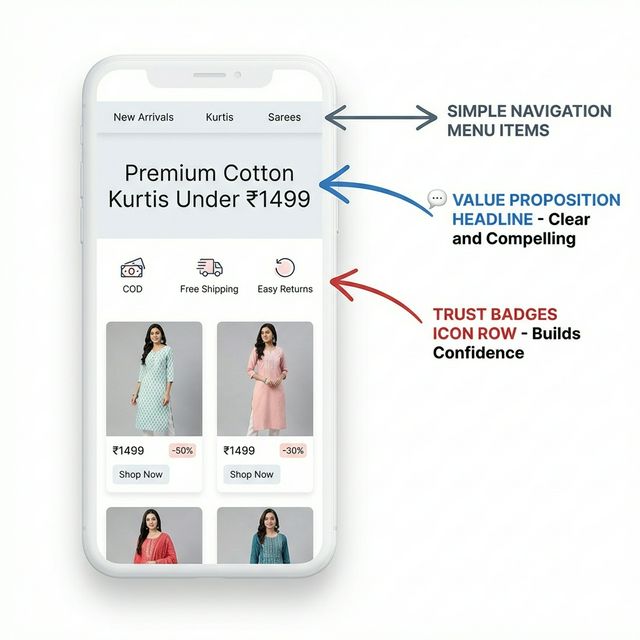
    Homepage optimization for Indian fashion ecommerce showing trust signals and clear navigation

    Your homepage must answer in 5 seconds:

    1. What do you sell?
    2. Who is it for?
    3. Why should I trust you?

    Example: Cotton Kurti Brand

    Bad headline:

    “Welcome to our store”

    Better:

    “Premium Cotton Kurtis Under ₹1499 – Perfect for Office & Daily Wear”

    Immediately clear.

    Add These Trust Signals (Critical for India)

    • COD Available
    • Free Shipping Above ₹999
    • Easy 7-Day Returns
    • 10,000+ Happy Customers
    • Made in India

    Indian buyers are skeptical. Trust reduces friction.

    Ask yourself:

    Does my homepage build confidence or confusion?

    B. Navigation Must Be Simple (Mobile First)

    Remember: 80–90% of Indian traffic is mobile.

    Your menu should look like:

    • New Arrivals
    • Kurtis
    • Sarees
    • Festive Wear
    • Sale
    • Track Order

    Not:

    • Collections
    • Explore
    • Lifestyle
    • Moodboards

    Clarity beats creativity.

    Step 2: Category Page Optimization (Your Real Sales Engine)

    Most Indian founders ignore this page.

    But category pages often convert more than homepages.

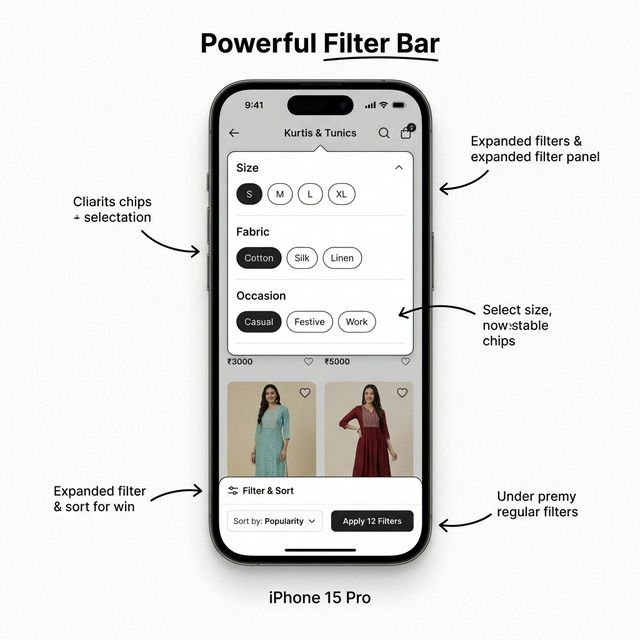
    Ecommerce category page design checklist including filters and sorting for Indian buyers

    What Your Category Page Must Have

    ✔ Sort by:

    • Price Low to High
    • Newest
    • Best Selling

    ✔ Filters:

    • Size (XS–XXL)
    • Fabric (Cotton, Rayon, Silk)
    • Price
    • Occasion (Office, Festive, Casual)

    If a customer searching “office kurti under 1200” cannot filter quickly — they leave.

    Add SEO Content to Category Pages

    Instead of empty pages, add 150–250 words.

    Example:

    “Buy cotton kurtis online in India at affordable prices. Our collection features breathable fabrics perfect for office wear…”

    This helps rank for:

    • Buy cotton kurti online India
    • Cotton kurti under 1000
    • Office wear kurtis for women

    Can you write 200 words describing your category?

    Yes.
    Then you can implement this today.

    Step 3: Product Page Optimization (Where 80% Revenue Is Decided)

    If there is one page you must perfect — this is it.

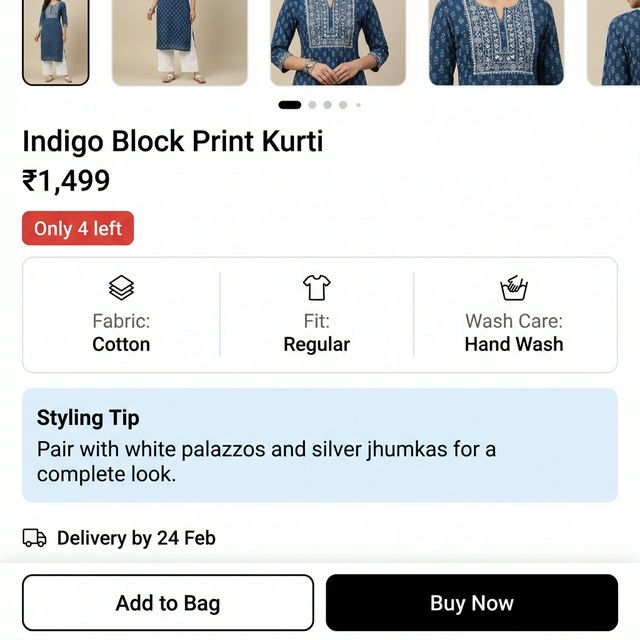
    Product page optimization checklist with urgency triggers and delivery estimation

    A. Images Sell Fashion

    Minimum required:

    • Front view
    • Back view
    • Close-up fabric
    • Model image
    • Size chart image
    • Video (optional but powerful)

    Indian customers zoom heavily before buying.

    B. Product Description Structure

    Don’t write essays.

    Use this format:

    Product Highlights:

    • Fabric:
    • Fit:
    • Length:
    • Wash Care:
    • Model Wearing Size:

    Styling Tip:

    “Pair this kurti with white palazzos and oxidised jewellery for a festive look.”

    This increases perceived value.

    C. Add Urgency & Scarcity

    Indian customers delay decisions.

    Add:

    • Only 4 left in stock
    • Selling Fast
    • 27 people viewed this today

    But don’t fake numbers. Keep it realistic.

    D. Delivery Estimation

    Very powerful.

    Show:
    “Delivery by 22–24 Feb to Hyderabad”

    It reduces hesitation.

    Ask yourself:

    Do I clearly show when the product will reach the customer?

    If no — implement it.

    Step 4: Cart Page Optimization (Reduce Drop-Off)

    Cart abandonment in India can go up to 70%.

    Let’s reduce it.

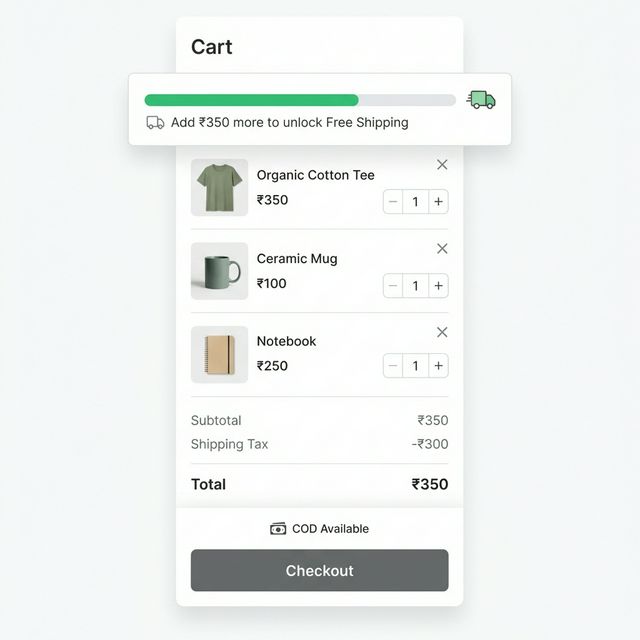
    Strategies to reduce cart abandonment in India including free shipping nudges and trust badges

    A. Free Shipping Threshold

    Show:
    “Add ₹350 more to unlock Free Shipping”

    This increases AOV.

    B. COD Option Visibility

    Many Indian customers check for COD before payment.

    Clearly show:
    COD Available

    If COD unavailable, be transparent.

    C. Remove Distractions

    Cart page should not show:

    • Blog posts
    • Too many cross-sells
    • Large banners

    Cart page = decision moment.

    Step 5: Checkout Optimization for Indian Ecommerce

    If you’re on platforms like Shopify or WooCommerce:

    Check this immediately.

    A. Guest Checkout Must Be Enabled

    Forcing account creation kills conversions.

    B. Reduce Form Fields

    Only ask:

    • Full Name
    • Phone
    • Address
    • Pincode

    Do not ask:

    • Gender
    • Alternate phone
    • Company name

    Every extra field = drop in conversion.

    C. Offer UPI

    India runs on UPI.

    If you don’t support:

    • UPI
    • COD
    • Net Banking

    You lose orders.

    Step 6: SEO Strategy for Indian Fashion Stores

    Now let’s talk traffic.

    Don’t Target Generic Keywords

    Wrong:

    • Sarees
    • Kurtis

    Right:

    • buy linen saree online
    • cotton kurti under 1200
    • office wear kurti for women India
    • bridal lehenga under 15000

    Buyer intent keywords convert better.

    Calculate Before Running Ads

    Example:

    CPC = ₹18
    Conversion Rate = 2%

    CPA = ₹900

    If your average margin is ₹700 — you lose ₹200 per sale.

    Most founders don’t calculate this.

    Ask yourself:

    Do I know my break-even CPA?

    If not — calculate today.

    Step 7: Google Ads Structure for Indian Fashion Stores

    1. Search Campaign

    Target high intent keywords:

    • buy silk saree online
    • best cotton kurti brand India

    CTR Benchmarks:

    • Brand keywords: 25%+
    • Non-brand: 8–15%

    Below 5%? Improve ad copy.

    2. Remarketing Campaign (Highest ROAS)

    Target:

    • Product viewers (last 30 days)
    • Cart abandoners
    • Instagram traffic

    Remarketing gives highest profitability.

    3. Negative Keywords (Stop Wasting Money)

    Add negatives like:

    • free
    • how to stitch
    • DIY
    • wholesale
    • jobs
    • training

    This prevents junk traffic.

    Step 8: WhatsApp & Retention Strategy (Very Important in India)

    Indians respond strongly to WhatsApp.

    After purchase:

    • Send order confirmation
    • Send delivery updates
    • Send styling suggestions
    • Send reorder reminders

    Instead of:
    “Buy again”

    Send:
    “Hi Priya, your cotton kurti pairs beautifully with white palazzos. Here’s 10% off on matching bottoms.”

    Retention > Acquisition.

    Step 9: Thank You Page Monetisation

    After purchase, show:

    • 10% off next purchase
    • Refer a friend & earn ₹200
    • Follow us on Instagram
    • Join VIP WhatsApp group

    You already paid for the customer. Maximize LTV.

    30-Day Implementation Plan

    Week 1

    Fix homepage & product pages

    Week 2

    Optimize cart & checkout

    Week 3

    Keyword research + negative keywords

    Week 4

    Launch small budget search campaign (₹20,000 test)

    Month 2
    Add remarketing

    Month 3
    Scale winning campaigns

    Final Self-Audit Checklist

    Answer honestly:

    • Is my product page better than competitors?
    • Is checkout friction-free?
    • Do I calculate CPA before ads?
    • Do I use remarketing?
    • Do I collect WhatsApp leads?

    If you fix these — you don’t need huge budgets.

    The Hard Truth for Indian Ecommerce Owners

    Most Indian fashion stores don’t fail because of competition.

    They fail because:

    • Weak conversion optimization
    • No clarity in positioning
    • Poor ad structure
    • No financial calculations
    • No retention strategy

    If you fix fundamentals, even ₹15–20K/month ad budget can become profitable.

  • DIY Shipping & Fulfillment Setup for Indian D2C Brands 2026: Complete Guide

    DIY Shipping & Fulfillment Setup for Indian D2C Brands 2026: Complete Guide

    Setting Up Shipping Yourself? Here’s the Full Picture

    Shipping looks simple until your first RTO, lost package, or weight dispute. This guide covers every step we handle for our fulfillment clients – so you can decide if DIY makes sense for your brand.

    Estimated time: 15-25 hours for full setup
    Ongoing time: 2-5 hours/week for management
    Technical skill: Low-Medium
    Cost: ₹0 for aggregator signup + per-shipment charges

    Phase 1: Strategy Decisions (Before Any Setup)

    Questions to Answer First

    1. Shipping cost model: Free shipping? Flat rate? Weight-based? Free above threshold?
    2. Delivery promise: Can you promise 3-5 days? 5-7 days?
    3. COD policy: Offer COD? With limits? Extra charge?
    4. Pincode coverage: Pan-India or specific states?
    5. Packaging: Standard boxes or custom branded?

    Phase 2: Aggregator Selection (Week 1)

    Don’t sign up with individual couriers. Use an aggregator for multi-courier access and better rates.

    Major Aggregators in India

    Aggregator Strengths Best For
    Shiprocket Best Shopify integration, WhatsApp tracking Most D2C brands
    Pickrr Good rates, reliable Cost-conscious brands
    Eshipz Advanced analytics Data-focused brands
    Delhivery Direct Single carrier reliability High volume brands

    Setup Steps

    1. Sign up for aggregator account
    2. Complete KYC (PAN, GST, bank details)
    3. Wait for approval (1-3 days)
    4. Add pickup address(es)
    5. Configure default weight/dimensions
    6. Set up wallet/payment method for COD remittance

    Phase 3: Shopify Integration (Week 1-2)

    1. Install shipping app from Shopify App Store
    2. Authenticate with aggregator account
    3. Map order statuses (fulfilled = shipped, etc.)
    4. Configure automatic order sync
    5. Set up shipping rate display at checkout
    6. Configure pincode serviceability check
    7. Test order flow: place order → sync → create shipment → print label

    Phase 4: Shipping Rules & Automation (Week 2)

    1. Set up courier allocation rules (Delhivery for metros, Xpressbees for Tier 2/3, etc.)
    2. Configure weight dispute auto-approval limits
    3. Set up NDR (Non-Delivery Report) handling workflow
    4. Configure RTO prediction rules (if available)
    5. Set up automated tracking notifications (SMS/WhatsApp)
    6. Configure COD remittance cycle preferences

    Phase 5: Packaging & Operations (Ongoing)

    1. Source packaging materials (boxes, mailers, tape)
    2. Create packing SOP for team
    3. Set up daily pickup schedule with couriers
    4. Configure label printing setup
    5. Create returns handling workflow
    6. Set up inventory sync (if using multiple channels)

    What Usually Goes Wrong (Why Brands Need Help)

    • Weight disputes: Couriers charge more, you lose margins
    • Courier allocation: Wrong courier for pincode = delays = RTO
    • NDR mismanagement: Failed attempts not followed up, orders return
    • Tracking gaps: Customers can’t track, flood support with queries
    • COD reconciliation: Missing remittances, manual tracking nightmare
    • RTO costs: 20-40% RTO eating all profit
    • Rate negotiation: Paying retail rates instead of volume discounts

    The Hidden Costs of Poor Shipping

    • RTO cost: ₹100-200 per failed delivery (forward + return)
    • Weight disputes: ₹20-50 extra per shipment if not managed
    • Support burden: 30-40% of customer queries are about delivery
    • Lost customers: Bad delivery experience = no repeat purchase

    Honest Assessment

    If you:

    • Have time to manage daily shipping operations
    • Can handle NDR follow-ups promptly
    • Don’t mind manual reconciliation work
    • Are comfortable negotiating with multiple couriers

    …then DIY shipping is manageable!

    If you want optimized courier allocation, proactive NDR management, and someone to handle the operational headaches – that’s what we do.

    Our Fulfillment Integration Service

    We set up optimized shipping operations:

    • Aggregator setup with negotiated rates
    • Smart courier allocation rules
    • WhatsApp tracking integration
    • NDR management workflows
    • RTO reduction strategies
    • Ongoing support and optimization

    → View our Fulfillment Service

    📦 Get shipping sorted: Chat with us on WhatsApp

  • COD Fraud in Indian Ecommerce 2026: Real Stories & How Smart D2C Brands Fight Back

    COD Fraud in Indian Ecommerce 2026: Real Stories & How Smart D2C Brands Fight Back

    The COD Fraud Epidemic Nobody Talks About

    Every week on Reddit’s r/IndianEcommerce and r/entrepreneur groups, a D2C founder shares the same horror story:

    “Got 47 orders yesterday. 31 were COD. 19 of those RTOed. My margin is gone. I’m literally paying to run this business.”

    COD fraud isn’t just an inconvenience – it’s killing profitable D2C businesses. Let’s break down the real problem and real solutions.

    The Brutal Economics of COD Fraud

    Here’s what a fraudulent COD order actually costs you:

    • Forward shipping: ₹60-100
    • Return shipping: ₹60-100
    • Packaging cost: ₹20-50
    • Product damage risk: 10-15% of returns are unsellable
    • Customer acquisition cost: ₹200-500 (wasted)
    • Team time: Order processing, follow-ups, returns management

    Total loss per fraudulent order: ₹400-800+

    If you’re running at 30% RTO on COD (common for new brands), and 50% of your orders are COD, nearly 15% of your total orders are pure loss.

    Types of COD Fraud (From Real Cases)

    1. Impulse Orders

    Customer orders at 2 AM after seeing your ad. By delivery day, they’ve forgotten, changed their mind, or bought elsewhere.

    Solution: Order confirmation call/WhatsApp within 2 hours

    2. Competitor Sabotage

    Competitors placing bulk fake orders to drain your inventory and cash flow.

    Solution: IP tracking, order velocity alerts, COD limits per customer

    3. Address Fishing

    Fake addresses to test if your brand ships to certain areas before placing larger orders fraudulently.

    Solution: Address verification, pincode serviceability at checkout

    4. Multi-Size Orders

    Customer orders 3 sizes of the same item, keeps one, refuses the other two COD deliveries.

    Solution: Limit variants per order, partial prepaid for multiple items

    5. Delivery Agent Fraud

    Some courier partners mark orders as “customer refused” when customer wasn’t even contacted.

    Solution: Multiple courier partners, delivery analytics, NDR management

    The 7-Point COD Fraud Prevention Stack

    1. WhatsApp Order Confirmation

    Send immediate WhatsApp message after COD order with order details. Ask for confirmation reply. No reply = flag for manual review.

    → Our WhatsApp Automation Service

    2. COD-to-Prepaid Conversion

    Offer ₹50-100 discount for prepaid within 1 hour of order. Convert 20-30% of COD to prepaid.

    Tools: Wato, Interakt, Shiprocket Engage

    3. Partial COD

    Collect ₹99-199 upfront via UPI, rest as COD. Massively increases order commitment.

    Apps: Partialy, Razorpay Magic Checkout

    4. IVR/OTP Verification

    Automated call or SMS OTP before order processing. Filters out fake numbers.

    Apps: Penguin COD, CODfirm, Kwik

    5. Smart COD Limits

    • No COD for orders under ₹500 (low commitment signals)
    • No COD for first-time customers in high-RTO pincodes
    • COD limit per customer (3 orders max)

    6. Pincode Risk Scoring

    Track RTO rates by pincode. Auto-disable COD for high-risk areas (40%+ RTO).

    7. Delivery Partner Optimization

    Use multi-courier aggregators with smart allocation based on pincode performance.

    → Our Fulfillment Integration Service

    Real Results from Brands We’ve Helped

    • Fashion D2C brand: Reduced RTO from 38% to 14% in 60 days
    • Beauty brand: Converted 32% of COD orders to prepaid via WhatsApp
    • Electronics brand: Identified and blacklisted 400+ fraudulent pincodes

    Stop Bleeding Money on COD Fraud

    We set up complete fraud prevention systems for Indian D2C brands:

    🛡️ Get a free fraud audit: Chat with us on WhatsApp

  • Shopify Store Development Cost in India 2026 – Complete Pricing Breakdown

    Shopify Store Development Cost in India 2026 – Complete Pricing Breakdown

    How Much Does a Shopify Store Cost in India in 2026?

    If you’re searching for “Shopify store development cost India” or “Shopify website price”, you’ve found the most comprehensive guide. We’ve built 150+ Shopify stores for Indian D2C brands, and we’re sharing exactly what things cost in 2026.

    Quick Answer: A professional Shopify store in India costs between ₹50,000 to ₹3,00,000+ depending on complexity. Here’s the complete breakdown.

    Shopify Subscription Plans (Monthly)

    Plan Monthly Cost Best For
    Basic Shopify ₹1,994/month New D2C brands (most start here)
    Shopify ₹7,447/month Growing brands with team access
    Advanced ₹30,164/month High-volume brands needing reports
    Shopify Plus ₹1.5L+/month Enterprise (₹10Cr+ revenue)

    Our recommendation: Start with Basic Shopify. Upgrade when you consistently hit ₹10L+ monthly revenue.

    Development Costs Breakdown

    Option 1: DIY / Template Setup (₹0 – ₹20,000)

    What you get:

    • Free Shopify theme (Dawn, Sense, etc.)
    • Basic customization yourself
    • No professional design

    Hidden costs: Your time, learning curve, likely redesign later when you scale.

    Option 2: Freelancer (₹15,000 – ₹50,000)

    What you get:

    • Theme customization
    • Basic pages setup
    • Limited revisions

    Watch out for: No post-launch support, inconsistent quality, may not understand Indian ecommerce requirements (GST, Shiprocket, Razorpay).

    Option 3: Professional Agency (₹50,000 – ₹1,50,000)

    What you get: (This is what we offer at Growww Tech)

    • Complete store setup with all pages
    • Razorpay payment gateway integration
    • Shiprocket/Delhivery shipping setup
    • WhatsApp automation integration
    • GST configuration & legal compliance
    • Mobile optimization & Core Web Vitals
    • Post-launch support (6 months)
    • Training session on store management

    See our Shopify development service →

    Option 4: Custom Design + Development (₹1,50,000 – ₹3,00,000+)

    What you get:

    • Custom UI/UX design via Figma
    • Unique brand experience
    • Custom features and integrations
    • Ideal for established brands with specific requirements

    Additional Costs to Budget For

    Domain (₹500 – ₹1,500/year)

    Register via GoDaddy, Namecheap, or directly through Shopify.

    Premium Theme (₹0 – ₹20,000 one-time)

    Free themes work fine for most brands. Premium themes (Impulse, Prestige, Motion) offer advanced features.

    Essential Apps (₹2,000 – ₹15,000/month)

    • WhatsApp automation (Wato/Interakt): ₹2,000-8,000/month
    • Email marketing (Klaviyo): ₹0-5,000/month
    • Reviews (Judge.me): ₹0-1,500/month
    • SEO apps: ₹0-2,000/month

    Third-Party Services

    • Razorpay: 2% transaction fee
    • Shiprocket: Per-shipment charges
    • Meta Ads: Variable (₹50,000+/month recommended)

    What’s Included in Growww Tech’s Package

    Our ₹75,000 – ₹1,25,000 package includes:

    • ✅ Complete store development (15-20 days)
    • ✅ Razorpay payment integration
    • ✅ Shiprocket/Delhivery shipping
    • ✅ WhatsApp automation setup
    • ✅ GST & legal compliance
    • ✅ Mobile optimization
    • ✅ 6 months support
    • ✅ Training session

    Not included: Shopify subscription, domain, premium apps, product data entry.

    Why Brands Choose Us Over Freelancers

    From Reddit and real conversations, here’s what brands struggle with when using freelancers:

    • “Freelancer disappeared after payment”
    • “Store works but no one knows how to update it”
    • “Razorpay integration took 2 months”
    • “Mobile site is broken, they say it’s extra cost to fix”

    We’ve built systems to avoid all these problems. 150+ launches, 4.9★ Google rating.

    Get an Exact Quote for Your Store

    Every brand is different. Tell us about your requirements and get a customized quote within 24 hours.

    💰 Get your free quote: Chat with us on WhatsApp

    Related Services:

  • Fast & Flexible Delivery: How Indian D2C Brands Are Reducing RTO in 2026

    Fast & Flexible Delivery: How Indian D2C Brands Are Reducing RTO in 2026

    The RTO Crisis That’s Killing Indian D2C Brands

    Reddit is full of frustrated D2C founders sharing the same story: “30% RTO rate on COD orders is eating all our profits.” If you’re running an Indian ecommerce brand, you’ve probably lived this nightmare.

    The reality is brutal:

    • RTO rates of 20-40% are common for COD orders
    • 50%+ RTO for new brands without verification systems
    • Double shipping costs (forward + return) on every failed delivery
    • Lost inventory – products often damaged or unsellable after return

    But smart brands are cracking this problem. Here’s how.

    Why RTO Happens (Real Reasons from Reddit)

    From hundreds of Reddit discussions, here are the actual reasons Indian D2C orders get returned to origin:

    1. Fake or Incomplete Addresses

    Especially in Tier 2/3 cities, customers provide vague addresses like “Near the big temple, blue house.” Delivery agents can’t find them.

    2. Low Purchase Intent on COD

    COD removes financial commitment. Customers order impulsively, then forget or change their mind by delivery time.

    3. Delivery Delays

    If delivery takes 7-10 days, customers lose interest. They may have bought elsewhere or no longer want the product.

    4. Customer Unavailability

    Failed delivery attempts because customer wasn’t home. After 2-3 attempts, order returns to origin.

    5. Fraudulent Orders

    Competitors placing fake orders, customers ordering multiple sizes intending to return most, or outright fake details.

    7 Proven Strategies to Reduce RTO

    1. COD to Prepaid Conversion via WhatsApp

    The single most effective strategy. After a COD order is placed, send a WhatsApp message offering a small discount (₹50-100) for prepaid payment.

    • Tools: Wato, Interakt, Shiprocket Engage
    • Result: 20-30% of COD orders convert to prepaid

    2. Phone/OTP Verification for COD

    Automated IVR call or OTP verification before processing COD orders filters out fake/frivolous orders.

    • Apps: Penguin COD, CODfirm, Kwik by Shiprocket
    • Result: 15-25% reduction in RTO

    3. Partial COD Payments

    Collect a portion (₹50-200) upfront via UPI/cards, rest as COD. Increases commitment without removing COD option.

    • Apps: Partialy, Razorpay Magic Checkout
    • Result: 30-40% RTO reduction reported by brands

    4. Address Verification

    AI-powered address validation flags incomplete or suspicious addresses before shipping.

    • Pincode serviceability check at checkout
    • Google Maps integration for precise locations

    5. Fast Shipping (Under 3 Days)

    Quick delivery = less time for customers to change their mind. Partner with multiple couriers for optimal coverage.

    • Tools: Shiprocket, Delhivery, Pickrr

    6. Pre-Delivery Customer Engagement

    WhatsApp messages throughout the journey:

    • Order confirmation with product image
    • Shipping notification with tracking
    • Out for delivery reminder
    • Delivery attempt notification

    7. RTO Analytics & Flagging

    Track RTO patterns by pincode, customer, or product. Flag high-risk orders for manual review or prepaid-only.

    The Complete RTO Reduction Stack

    At Growww Tech, we set up comprehensive RTO reduction systems:

    • Shopify Store with smart checkout flows
    • WhatsApp Automation for COD-to-prepaid conversion
    • Shipping Integration with multi-courier support
    • Performance Marketing targeting high-intent audiences

    📉 Reduce your RTO: Get a free RTO audit on WhatsApp